Riddles and logic puzzles: a step-by-step solving guide
Most “brain training” apps sell logic puzzles like they’re tiny treadmills for your IQ. Do three grids before breakfast, unlock a badge, feel your frontal lobe doing push-ups. Cute. Also mostly nonsense.
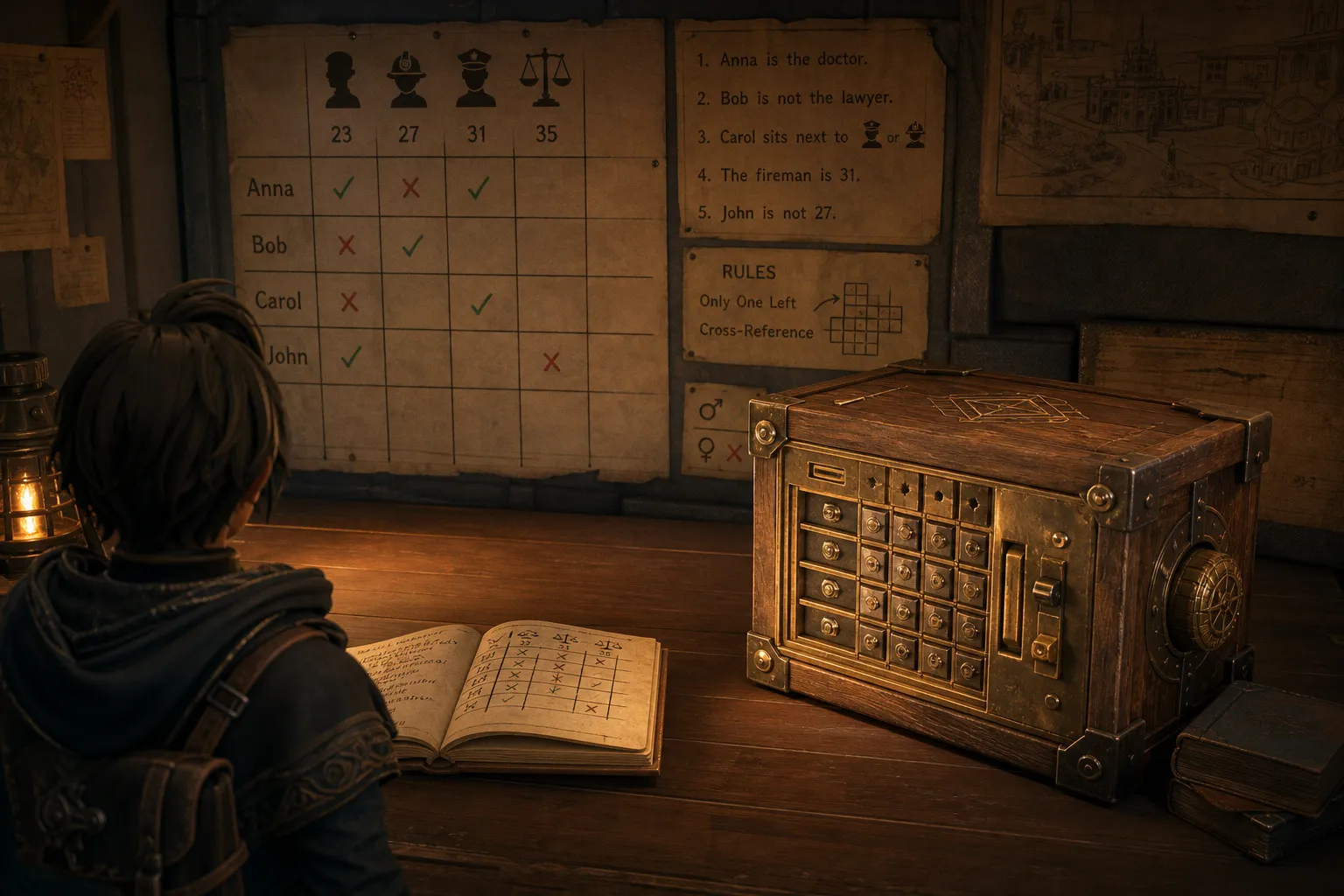
The good ones do one thing beautifully: they force you to stop guessing. A proper logic puzzle gives you a closed little universe — people, jobs, times, colors, prizes, suspects, whatever — and enough clues to prove one arrangement. Not “feel.” Not “vibe.” Prove. If you want to know how to solve logic puzzles without turning the page into a crime scene of random marks, you need a method. Here’s mine.
The anatomy of a logic grid: mastering the matrix
A grid-based logic puzzle is basically a bookkeeping machine. It tracks relationships between categories. That sounds dry because it is. Dry is good. Dry saves you from the dopamine hit of a premature answer.
A typical puzzle might give you:
- four people: Anna, Bob, Carol, Dave
- four jobs: doctor, lawyer, engineer, chef
- four pets: cat, dog, parrot, turtle
- four cities: Denver, Boston, Austin, Miami
Your job is to match one item from each category with exactly one item from every other category. Anna has one job, one pet, one city. Bob does too. No duplicates unless the puzzle explicitly says otherwise, which standard grid puzzles usually do not.
The grid lets you record two kinds of information:
- a positive match, usually marked with a tick, circle, or filled dot
- a negative match, usually marked with an X
That is the whole engine. Every smart move you make is just a disciplined way of adding ticks and Xs until the grid caves in and reveals the solution.
Build the grid before you “solve” anything
Do not read the clues and start performing mental gymnastics. That is how people end up whispering, “Wait, if the turtle is not in Boston unless Dave is the chef…” like they’ve been trapped inside a tax form.
Set up the puzzle first.
For a small puzzle, you can draw the categories across the top and down the side, then fill only the pairings you need. Many printed logic-grid puzzles already do this. Digital puzzle apps often give you a tap-to-mark matrix. Fine. Use it. But understand what the tool is doing.
Here is the practical rule: every clue should leave a visible trace.
If the clue says “Anna is the doctor,” mark Anna-doctor as yes. Then immediately mark Anna as not lawyer, not engineer, not chef. Also mark Bob, Carol, and Dave as not doctor. One yes creates a ring of no.
That second part is where beginners bleed time. They mark the positive and forget the fallout. The puzzle does not forget. It waits. Then punishes you later.
A tick is not a decoration. It is a little bomb that blows up the rest of its row and column.
For solving riddles step by step, the same principle applies even when there is no visible grid. A riddle still has variables, constraints, and eliminations. The “grid” may live in a notes app or in your head, but if the riddle has multiple entities and multiple attributes, write them down. Memory is not a strategy. Memory is a leaky bucket wearing a confident hat.
Decoding clue types: direct, negative, relational, conditional
Logic puzzles look varied because the wording changes. Under the hood, the clues fall into repeatable types. Once you can classify the clue, you can decide what kind of mark it deserves.
| Clue type | What it sounds like | What you do with it |
|---|---|---|
| Direct clue | “Anna is the doctor.” | Mark one positive match, then eliminate the rest of that row and column. |
| Negative clue | “Bob is not the lawyer.” | Mark one negative match. Save it; it may matter later. |
| Relational clue | “Carol sits next to the engineer.” | Record a relationship, often not a fixed match yet. Use position or category constraints. |
| Comparative clue | “The chef arrived before the person from Miami.” | Create an ordering constraint. Eliminate impossible positions. |
| Conditional clue | “If Dave has the turtle, then Bob is in Austin.” | Do not assume either part is true. Track the dependency. |
| Identity-transfer clue | “The 23-year-old is the fireman.” | Link two attributes; later, attach them together to a person. |
Direct clues are candy. You unwrap them and mark the grid. Negative clues are crumbs. Not exciting, but they build the trail. Relational and conditional clues are where the puzzle starts throwing elbows.
Direct clues: cash them in immediately
If a clue gives a direct match, do not admire it. Spend it.
“Anna is the doctor” means:
1. Anna = doctor.
2. Anna ≠ lawyer, engineer, chef.
3. Bob ≠ doctor.
4. Carol ≠ doctor.
5. Dave ≠ doctor.
This is the moment where grid puzzles become satisfying. One fact produces several consequences. That is deduction. Not mystical. Just relentless.
Negative clues: small Xs, big consequences
“Bob is not the lawyer” feels weak. It is one X. Nothing to brag about. But later, if Bob is also not the doctor and not the chef, then Bob must be the engineer. That is the “Only One Left” rule, and it is the closest thing logic grids have to a trapdoor.
Negative clues also prevent false leaps. If you forget one, you may build a tidy-looking solution that violates the original evidence. That is not a solution. That is fan fiction.
Relational clues: do not flatten them too early
Relational clues describe how items relate without necessarily saying what they are.
Examples:
- “Carol sits next to the engineer.”
- “The person with the parrot arrived immediately before Bob.”
- “The lawyer lives somewhere east of the chef.”
- “The dog owner is not seated beside Anna.”
These are not always grid marks on first contact. Sometimes they are side notes. Sometimes they eliminate positions. Sometimes they create paired possibilities.
If the puzzle has ordered slots — table seats, race placements, arrival times — draw them. Put the relation near the slots. “Parrot immediately before Bob” means Bob cannot be first, and the parrot owner cannot be last. That is already useful. Mark those eliminations.
Pronouns and gendered wording are not flavor text
A clue that says “he,” “she,” or uses a gender-specific occupation can eliminate options. If the puzzle establishes that Anna and Carol are women, while Bob and Dave are men, then a clue saying “he is not the chef” does not apply to everyone equally. It narrows the field.
This is not about being clever. It is about reading what is actually on the page. Puzzle writers hide constraints in plain English because solvers love skipping plain English and chasing theatrics.
A clean solving sequence that does not rely on vibes
Here is the method I use when I am crash-testing a logic puzzle app and want to know whether the puzzle is fair or just badly designed. It works for paper grids, browser puzzles, and most mobile logic games that pretend they invented deduction because they added confetti.
1. List every category and confirm the size.
Is it 3x3, 4x4, 5x5? Are there four people and four objects, or five people and six times? Mismatched category sizes change the rules. Standard grids usually pair one-to-one across equal sets.
2. Enter all direct clues first.
These are your anchors. Mark the positive, then eliminate the rest of the row and column. Do not move on until the fallout is visible.
3. Add all explicit negative clues.
Xs look boring. Add them anyway. Especially the ones involving central categories like names or positions.
4. Translate relational clues into constraints.
Use side notes for “next to,” “before,” “after,” “older than,” “same as,” and “not adjacent.” If a relation makes a position impossible, mark the X immediately.
5. Scan for “Only One Left.”
In any row or column, if all but one option are eliminated, the remaining option is true. Mark it, then trigger the row-and-column fallout again.
6. Cross-reference linked facts.
If John is 23, and the 23-year-old is the fireman, then John is the fireman. The puzzle expects you to transfer the relationship. Do it aggressively.
7. Repeat the scan, not the guessing.
Go back through rows, columns, and clues. Each new tick can unlock another X. Each new X can expose a final remaining match.
That loop is the whole game. Mark. Eliminate. Transfer. Scan. Repeat.
Not glamorous. Very effective.
Advanced deduction: cross-referencing and the “Only One Left” rule
If direct clues are the front door, cross-referencing is the lockpick. It lets you move information through the grid even when no clue states the final answer out loud.
Say the clues give you:
- John is 23.
- The 23-year-old is the fireman.
Neither clue says “John is the fireman.” But together they do. That is cross-referencing: two attributes attach to the same hidden entity, so they attach to each other.
In a grid, this often means moving a positive mark across subgrids. If John matches 23, and 23 matches fireman, then John matches fireman. Once John matches fireman, John is not doctor, not lawyer, not chef; and the other people are not fireman. More fallout. More Xs. Less fog.
The bigger the puzzle, the more this matters. Advanced grid libraries sometimes run puzzles with five linked categories and six options in each category. At that scale, you are not “holding it in your head.” No, you are not. Your head is already dropping packets.
How to scan for “Only One Left”
The “Only One Left” rule is brutally simple: if all options but one in a row or column are eliminated, the remaining option must be correct.
Example:
| Person | Doctor | Lawyer | Engineer | Chef |
|---|---|---|---|---|
| Anna | X | X | ? | X |
| Bob | ? | X | X | X |
| Carol | X | ? | X | X |
| Dave | X | X | X | ? |
Anna must be the engineer. Bob must be the doctor. Carol must be the lawyer. Dave must be the chef.
Do not wait for a clue to announce this. The grid already has. This is where many solvers stall: they read the next clue instead of interrogating the marks they already made.
A good rhythm:
- scan each row for one remaining blank;
- scan each column for one remaining blank;
- whenever you place a positive mark, wipe out the rest of its row and column;
- after every major clue, scan again.
Yes, it feels repetitive. That is the point. Spaced repetition is useful in learning because it makes the brain revisit material at intervals. Logic grids use a harsher cousin of that idea: repeated scanning forces weak implications to surface. The app will not always do this for you. Some do. Some hide half the useful information behind a premium animation and call it “training.”
Riddles are not grids, but they still obey constraints
Classic riddles and brain teasers can look less formal. No table. No categories. Just a paragraph trying to smirk at you.
The mistake is treating them as wordplay first. Some are wordplay, sure. But many riddles are compact logic problems. They still have constraints.
Take a riddle style like: “A man looks at a portrait and says, ‘Brothers and sisters I have none, but that man’s father is my father’s son.’ Who is in the portrait?”
The method is not to chant the sentence until enlightenment arrives. Break it.
- “Brothers and sisters I have none” means the speaker is an only child.
- “My father’s son” must be the speaker himself.
- “That man’s father is my father’s son” becomes “that man’s father is me.”
- Therefore the portrait shows the speaker’s son.
That is solving riddles step by step. Strip language. Replace pronouns. Track identity. Kill ambiguity.
For lateral riddles, the same discipline helps, but with a warning: some riddles rely on hidden assumptions rather than strict deduction. Those can be fun. They can also be cheap. If a puzzle requires information it never gave you and could not reasonably expect you to infer, it is not clever. It is a mugging.
A fair puzzle makes you feel foolish after the answer. An unfair one makes you feel cheated. Learn the difference.
Navigating complexity: from Karuji grids to multi-category links
Once you get comfortable with standard grids, puzzle makers start adding density. More categories. More indirect clues. Less mercy.
Karuji is a useful example because it strips away some surface clutter. Introduced in 2011, it is a pure logic puzzle genre that standardizes grid deduction by using letters from A to Z instead of names or numbers. Difficulty can scale through grid sizes such as Gold at 3x3, Platinum at 4x4, and Diamond at 5x5.
That sounds sterile. It is. But sterility has an upside: no fake story about bakers, parrots, and suspicious train schedules. Just logic.
A 3x3 puzzle is usually a warm-up. A 4x4 puzzle starts to punish sloppy marking. A 5x5 puzzle makes casual memory collapse. Once you enter larger multi-category territory — say five linked categories with six options each — the game changes from “can I see the answer?” to “can I maintain a reliable evidence system?”
Here is how I scale my method when the puzzle gets nastier:
| Puzzle size | What usually breaks | What to do instead |
|---|---|---|
| 3x3 | Overconfidence | Still mark every negative; small puzzles teach bad habits because they let you get away with laziness. |
| 4x4 | Missed fallout from positives | After every tick, clear the row and column before reading another clue. |
| 5x5 | Relational clue overload | Keep side notes for ordering, adjacency, and paired possibilities. Do not force them into the grid too early. |
| 5 categories x 6 options | Cross-link fatigue | Work category by category, then run systematic scans. Random clue-hopping becomes sludge. |
The average standard logic puzzle often sits in that 12–15 minute range when it is fair and moderately complex. Faster does not mean smarter. Sometimes it means you guessed and got lucky. Luck is not a solving strategy. It is a loan shark.
Use notation that you can survive
Your marks should be boring and consistent.
I use:
- X for impossible.
- ✓ or filled dot for confirmed.
- ? only in notes, not as grid clutter.
- A/B in side notes for paired possibilities, such as “chef = Boston or Miami.”
- arrows for ordering clues, such as “parrot < Bob” when one comes before the other.
The key is not the symbol. The key is that you never have to ask, “What did I mean by this squiggle?” If your notation needs a decoder ring, it has failed.
In app-based puzzles, watch for interface traps. Some apps let you mark maybe-candidates. Some auto-eliminate after positives. Some do not. Some make it too easy to mis-tap, then act smug when you request a hint. Before judging your own reasoning, understand what the interface is recording.
Common pitfalls: why guessing undermines your progress
Guessing feels efficient because it creates movement. That is the dopamine hit. Your grid was stuck; now it is full of marks. Wonderful. You have built a beautiful lie at high speed.
In a well-designed logic puzzle, guessing is not the primary strategy. It can be used as a last-resort contradiction test in some advanced solving contexts, but if you are learning, avoid it. Guessing masks the exact skill you are trying to build: deriving consequences from constraints.
Here are the traps I see constantly.
Mistake 1: marking the clue but not the consequences
You mark Anna as doctor and move on. No. Finish the job. Eliminate every other job for Anna and eliminate doctor for everyone else. A positive match is never isolated.
Mistake 2: treating “not” as weak information
Negative clues are the scaffolding. A single X may do nothing now, then complete a row ten minutes later. If you skip small eliminations, you rob the puzzle of its own machinery.
Mistake 3: collapsing relational clues into assumptions
“Carol sits next to the engineer” does not mean Carol is the engineer. It does not mean Carol likes engineers. It means adjacency. Track adjacency. Do not invent intimacy.
Mistake 4: ignoring category exclusivity
If the puzzle uses one-to-one matching, one person cannot have two jobs and two people cannot share the same job. This sounds obvious until a tired solver marks Bob as chef and later lets Dave remain chef because the row “looked fine.” Rows and columns both matter.
Mistake 5: using hints too early
A hint can be useful if it explains a missed deduction. A hint that simply reveals a mark is brain candy. You get the answer and lose the training. If an app offers hints, use them only after you have rescanned:
1. every row;
2. every column;
3. every direct clue;
4. every relational clue;
5. every linked category pair.
If nothing moves after that, take the hint. Then ask what you missed. Do not just continue. That is how apps turn learning into button pressing.
How to test whether a puzzle is fair
Not every puzzle deserves your patience. Some are elegant. Some are sludge. Some mobile puzzle packs appear to be generated by a bored spreadsheet that has never loved a human being.
A fair logic puzzle should have:
- A unique solution. If two complete arrangements satisfy every clue, the puzzle is broken.
- Enough information for deduction. You should not need outside trivia unless the puzzle clearly frames itself that way.
- Clear category rules. If each item is used once, say so or make it standard for the format.
- Clues that resolve cleanly. Ambiguous pronouns, vague ordering, and sloppy wording can wreck deduction.
- Difficulty from interaction, not obscurity. Hard should mean “many linked constraints,” not “the clue was written like a haunted fortune cookie.”
This matters in educational gaming because puzzle quality is the curriculum. A logic app with bad grids is not “training reasoning.” It is training tolerance for nonsense. Different muscle.
Strong puzzle libraries can offer huge numbers of unique puzzles — some collections boast tens of thousands — but volume alone means nothing. I would rather solve 20 well-constructed grids than wade through 2,000 autogenerated duds wearing a shiny “mental fitness” badge.
A practical solve-through pattern for any new grid
When I open a fresh logic puzzle, I follow the same sequence every time. It keeps me honest. More importantly, it keeps the puzzle from seducing me into random leaps.
First pass: harvest the obvious
Read every clue once. Mark direct positives and explicit negatives. Do not try to solve the whole thing yet. You are loading the grid.
Look for words like:
- “is”
- “is not”
- “neither”
- “either/or”
- “before”
- “after”
- “next to”
- “immediately”
- “older than”
- “younger than”
- “if”
These are not decorative. They are machinery.
Second pass: trigger eliminations
For every positive mark, eliminate the row and column. Then scan for “Only One Left.” This is often where the first real chain reaction happens.
If a row has three Xs and one blank in a 4x4 puzzle, mark the blank positive. Then eliminate again. Keep going until the grid stops producing free consequences.
Third pass: process relationships
Now return to relational clues. With new positives and negatives in place, old vague clues become sharper.
“The dog owner arrived before the lawyer” is not very helpful when all time slots are open. But if the lawyer cannot be first or second, and the dog owner cannot be last, the clue starts biting. Ordering constraints gain power as the grid fills.
Fourth pass: cross-reference
Move facts across categories.
If:
- Emma = green shirt
- green shirt = 9:30 appointment
Then:
- Emma = 9:30 appointment
That one transfer may unlock a different category. Do not wait for the puzzle to restate it. It will not. That is your job.
Fifth pass: audit the solution
Before declaring victory, check every clue against your final grid. Not some clues. Every clue. Logic puzzles are very good at producing almost-right answers, especially when you guessed once and forgot you guessed.
A correct solution should feel boring at the end. Every clue fits. Every category has one match. No duplicates. No “well, maybe.” The grid shuts up.
So, should you use riddles and logic puzzles for brain training?
Yes, with the hype surgically removed.
Riddles and logic puzzles are excellent for practicing attention, working-memory management, constraint tracking, and verbal precision. They can train habits: slow down, mark evidence, test implications, resist the shiny wrong answer. Those habits matter. But no, a puzzle app does not get to imply that a daily grid will permanently jack up your IQ. The evidence for sweeping brain-training claims is debated, and the marketing departments know exactly how much fog they can pump into the room.
Download a logic puzzle app if it gives you fair grids, clean notation, and explanations for deductions. Use riddles if you enjoy language traps and identity puzzles. Bring a pencil, not a fantasy about instant cognitive enhancement.
The blunt version: if you want quick dopamine, play anything. If you want actual deduction practice, solve slowly, mark everything, and make the puzzle prove itself.