Logic puzzles and answers: a five-step grid deduction method
Logic puzzles and answers are frequently treated as a matter of intuition. They are not.
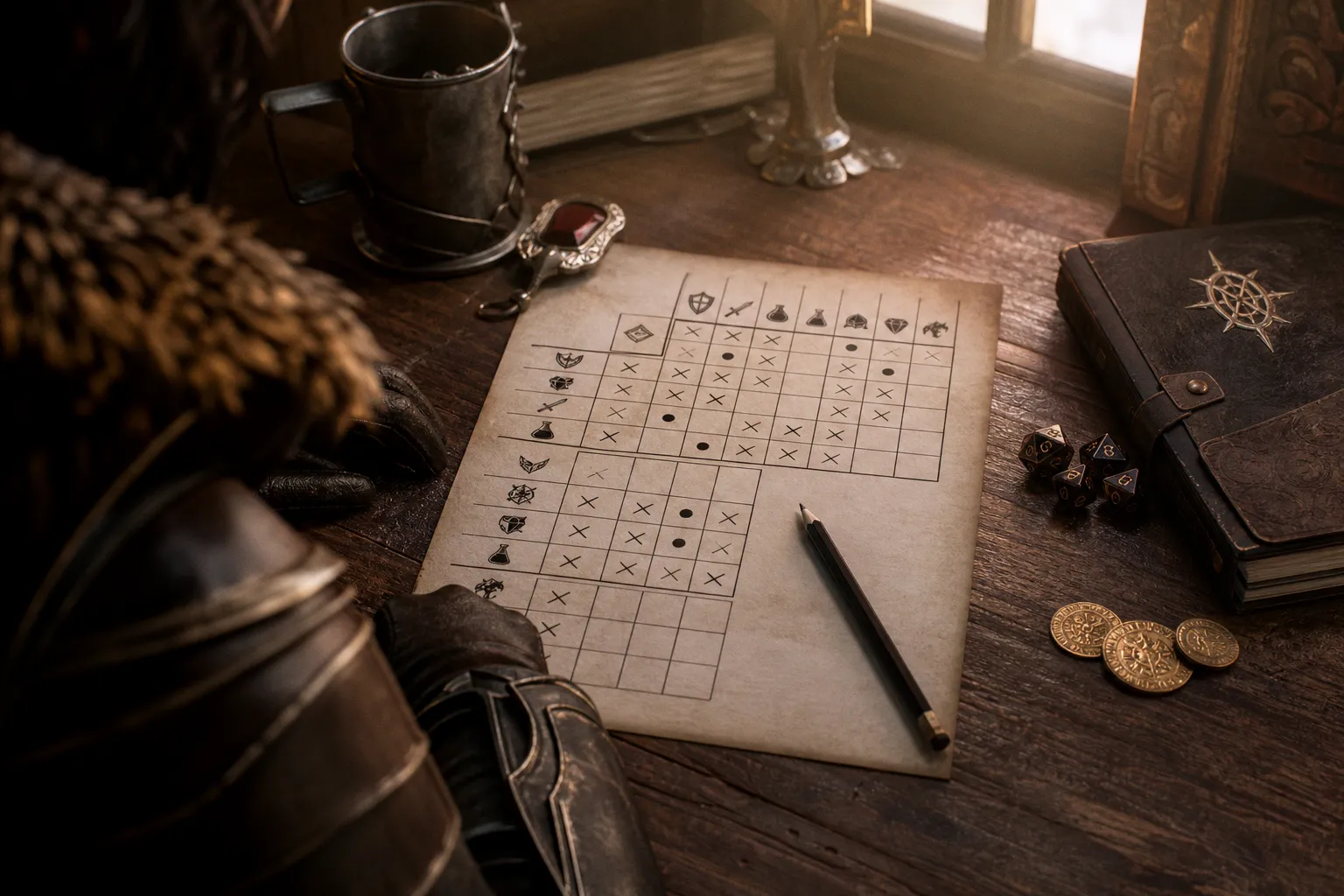
A standard logic grid puzzle is a constrained matching system: several categories contain the same number of items, and the solver must establish a one-to-one relationship among them from a finite set of clues.
The answer does not emerge from a lucky guess. It emerges when every possible pairing has been reduced to one of two states: confirmed or eliminated. The grid is therefore not decoration around the puzzle; it is the solver’s external memory system. Used correctly, it lowers cognitive load by recording deductions that would otherwise have to be retained and rechecked mentally.
This five-step method is an organized workflow rather than an official or scientifically validated protocol. Its purpose is practical: convert natural-language clues into a reliable sequence of marks, eliminations, and consistency checks.
The anatomy of a logic grid: one-to-one constraints
A logic grid puzzle commonly includes three or more categories of equal size. A small puzzle might ask a solver to match four people with four drinks and four arrival times. A larger one might connect names, occupations, cities, objects, days, and prices.
The key rule is one-to-one matching:
- Each person has exactly one drink.
- Each drink belongs to exactly one person.
- Each person has exactly one arrival time.
- Each arrival time belongs to exactly one person.
If Maya is confirmed as the person who drank tea, then Maya cannot have coffee, water, or juice. Equally, nobody else can have tea. One positive match generates multiple negative marks immediately.
For three categories, the worksheet needs three pairwise sub-grids:
| Category pairing | What it records |
|---|---|
| People × Drinks | Which person had which drink |
| People × Times | Which person arrived at which time |
| Drinks × Times | Which drink corresponds to which time |
A four-category puzzle requires six pairwise sub-grids. Five categories require 10. That expansion is why difficult logic grid puzzles can feel overwhelming even when each individual clue appears short: the number of relationships rises much faster than the number of visible labels.
Each cell in a sub-grid has only two meaningful final states:
| Mark | Meaning | Consequence |
|---|---|---|
| ✓ | Confirmed match | Eliminate every other option in that row and column |
| × | Eliminated pairing | Retain the cell as unavailable for all later deductions |
| Blank | Undecided | Do not infer more than the evidence supports |
The distinction between a blank and an elimination is operationally important. A blank is not evidence. It is simply an unresolved possibility. Many incorrect brain teaser answers begin when a solver unconsciously upgrades “not disproven” into “probably true.”
A logic grid does not reward speculation. It rewards complete bookkeeping under one-to-one constraints.
Logic grids are also not Sudoku. Sudoku uses one grid and placement rules for digits. Logic puzzles use relationship clues, while the grid functions as a record of possible and impossible pairings. The cognitive operations overlap only at a broad level: both require constraint tracking, but the deduction mechanics are different.
Step 1: Map the grid and mark direct clues
Before interpreting subtle wording, build the full category map. Write every item in a stable order and label the sub-grids clearly. Changing the sequence of names or times halfway through the puzzle creates avoidable transcription errors.
Suppose the categories are:
- People: Maya, Owen, Priya, Theo
- Drinks: coffee, juice, tea, water
- Arrival times: 8:00, 8:30, 9:00, 9:30
The grid should contain People × Drinks, People × Times, and Drinks × Times. The solver does not need to draw a giant combined matrix; pairwise grids are more readable and make chained deductions easier to audit.
Start with direct clues. These are clues that establish a relationship immediately or rule out a relationship without requiring any prior inference.
Examples:
1. “Priya drank tea.”
Mark Priya × tea as ✓. Then place × marks in Priya’s remaining drink cells and in tea’s remaining people cells.
2. “Theo did not arrive at 8:00.”
Mark Theo × 8:00 as ×. Nothing else follows yet.
3. “The coffee drinker arrived at 8:30.”
Mark coffee × 8:30 as ✓ in the Drinks × Times grid. Eliminate coffee from the other times and eliminate 8:30 from the other drinks.
4. “Owen did not drink water.”
Mark Owen × water as ×. Again, do not make a positive assignment from a single exclusion.
The order of clue processing matters less than the quality of the marks. Direct clues should be entered first because they create the highest-certainty anchors. Those anchors reduce the branching factor for every later clue.
A common error is marking only the positive relationship. If Priya × tea is confirmed but the row and column are left otherwise blank, the grid no longer reflects the one-to-one rule. The solver will revisit possibilities that are already impossible, increasing cognitive load and making contradictions harder to trace.
Use symbols consistently
There is no universal symbol convention, but the system should remain fixed throughout one puzzle. A check mark and an X are adequate. Some solvers use dots for tentative notes; that approach can work, but only if tentative notes are visibly distinct from final deductions.
For most logic grid puzzles with solutions, a disciplined two-state system is safer:
- ✓ for a relationship established by a clue or a necessary deduction
- × for a relationship eliminated by a clue or a necessary deduction
- blank for everything else
The grid should show what is known, not what the solver is considering.
Step 2: execute forced eliminations and hidden singles
Once direct clues are in place, inspect every row and column for forced outcomes. This is where many puzzles begin to move without any advanced interpretation.
A forced match occurs when all but one cell in a row or column have been eliminated. In puzzle terminology, this is often called a hidden single: the remaining option was not stated directly, but it is the only configuration compatible with the one-to-one constraint.
If Maya cannot have coffee, juice, or water, then Maya must have tea. Mark Maya × tea as ✓ and complete all associated eliminations.
The same logic applies by column. If coffee cannot belong to Maya, Owen, or Theo, then coffee must belong to Priya. A row-based and column-based scan are equally necessary. Solvers who inspect only each person’s options often miss an answer that is visible from the drink’s side of the grid.
A reliable scan cycle is:
1. Check each row for three eliminations and one blank.
2. Check each column for three eliminations and one blank.
3. Convert every forced blank into a ✓.
4. Complete the required row-and-column eliminations generated by that ✓.
5. Repeat the entire scan because each new match may produce another forced match elsewhere.
This is not busywork. It is the core propagation loop of a logic puzzle. A single confirmed pairing can constrain two categories directly and a third category indirectly.
Consider this partial People × Drinks grid:
| Person | Coffee | Juice | Tea | Water |
|---|---|---|---|---|
| Maya | × | × | ✓ | × |
| Owen | × | × | × | |
| Priya | ✓ | × | × | × |
| Theo | × | × | × | ✓ |
Owen’s juice is not a guess. It is forced because every alternative has been eliminated. The grid is effectively carrying out a small constraint-satisfaction calculation.
When one option remains, it is no longer an option. It is the answer for that row or column.
The typical failure at this stage is incomplete propagation. A solver confirms Owen × juice but forgets to mark juice as unavailable to Maya, Priya, and Theo. That omission may not break the puzzle immediately. It becomes expensive later, when the grid incorrectly appears to allow combinations that have already been ruled out.
Step 3: cross-reference sub-grids for chained deductions
Direct matches and hidden singles handle local constraints. Harder logic puzzles and answers depend on cross-referencing: using an established relationship in one sub-grid to derive a relationship in another.
Assume the grid shows:
- Owen drank juice.
- Juice was associated with 9:00.
The People × Drinks grid establishes Owen ↔ juice. The Drinks × Times grid establishes juice ↔ 9:00. Therefore, the People × Times grid must show Owen ↔ 9:00.
This is a chained deduction. The relationship transfers through a shared attribute:
Owen → juice → 9:00
The worksheet may contain three separate grids, but logically they describe one integrated system. If information does not travel across those grids, the solver is using only part of the available structure.
A productive way to perform cross-referencing is to locate the shared item, then compare its confirmed and eliminated pairings across the relevant sub-grids.
For example:
- In People × Drinks, Theo cannot have coffee.
- In Drinks × Times, coffee is confirmed at 8:30.
- Therefore, in People × Times, Theo cannot be 8:30.
The deduction does not require knowing Theo’s drink. Coffee’s association with 8:30 is enough to transfer the elimination.
The same operation works for positive matches:
| Known relationship A | Known relationship B | Derived relationship |
|---|---|---|
| Priya = tea | Tea = 9:30 | Priya = 9:30 |
| Coffee = 8:00 | Owen ≠ coffee | Owen ≠ 8:00 |
| Maya = water | Water ≠ 8:30 | Maya ≠ 8:30 |
| Theo ≠ juice | Juice = 9:00 | Theo ≠ 9:00 |
This is the point at which a grid becomes more effective than mental tracking. The solver can inspect a confirmed connection in one location, locate the same attribute elsewhere, and make a transfer without reconstructing the entire puzzle state.
Avoid invalid reverse inference
Cross-referencing is powerful because it is precise, not because it permits arbitrary association.
If the clue says, “The person who arrived at 8:00 drank coffee,” then coffee = 8:00. In a standard one-to-one puzzle, the relationship is bidirectional within those two categories: the coffee drinker is the 8:00 arrival.
But if a clue says, “Owen arrived before the tea drinker,” the clue does not identify either Owen’s drink or the tea drinker’s time. It establishes an ordering constraint, not a direct match. Treating it as a direct association is a category error.
The practical rule is simple: transfer only what the clue and existing marks logically establish. A relationship may be definite, impossible, or unresolved. There is no fourth state called “seems likely.”
Step 4: manage conditional clues through iterative review
Conditional and relational clues are usually the highest-load part of a puzzle. They often look informative at the start but cannot be fully applied until direct matches and cross-grid links reduce the candidate set.
Examples include:
- “The tea drinker arrived later than Owen.”
- “Neither Maya nor the 8:30 arrival drank water.”
- “The person from Leeds did not choose the blue item.”
- “The red item belonged to someone other than Priya, but it was paired with the 9:00 arrival.”
- “The person who chose the puzzle book was not the person who arrived first.”
These clues should not be ignored. They should be parsed into their actual logical components and revisited as the grid changes.
Take the clue: “Neither Maya nor the 8:30 arrival drank water.”
It contains two eliminations:
- Maya ≠ water
- 8:30 ≠ water
The second mark belongs in the Drinks × Times sub-grid, not the People × Drinks sub-grid. Splitting multi-part clues prevents a frequent error: recording only the most obvious half of a statement.
Now take: “Owen arrived before the tea drinker.”
At the beginning, this may create no immediate marks if all times remain available. But once Owen is narrowed to 8:30, the tea drinker can no longer be at 8:00 or 8:30. If tea is later confirmed at 9:00, Owen must be at either 8:00 or 8:30. If 8:30 has already been removed for Owen, then he is forced to 8:00.
The clue did not change. The grid state changed enough for the clue to yield deductions.
A disciplined review process works better than repeatedly rereading every sentence without a purpose:
1. Process direct matches and direct exclusions.
2. Run the forced-elimination scan.
3. Cross-reference confirmed and excluded relationships across sub-grids.
4. Revisit every conditional, comparative, neither/nor, and unaligned-pair clue.
5. Record only deductions that now follow necessarily.
6. Return to the forced-elimination scan.
This loop is the main gamification loop of the puzzle format, though it is not gamification in the marketing sense. Each correct update creates a more constrained board, which exposes the next available deduction. The reward is informational: ambiguity declines in observable increments.
Translate wording before solving it
Natural language is often more ambiguous to the solver than the underlying logic. Rewrite complex clues in neutral symbolic terms on scratch paper if necessary.
For instance:
- “The coffee drinker was not Priya” becomes coffee ≠ Priya.
- “Maya was not the 9:00 arrival” becomes Maya ≠ 9:00.
- “The green item was chosen after the book” becomes time(green) > time(book).
- “The person with juice was not the person from Rome” becomes juice ≠ Rome.
This translation step is not cosmetic. It separates the clue’s semantic meaning from its grammatical style, reducing the chance that an exclusion is mistaken for an assignment.
A well-constructed puzzle should resolve through deduction rather than unsupported trial and error. If the grid reaches a point where several candidates remain and no clue produces a necessary mark, review the transcription first. In many cases, the problem is not that the puzzle requires a guess; it is that one earlier elimination was missed or one conditional clue was entered into the wrong sub-grid.
Step 5: perform final consistency checking before accepting answers
A completed grid can still contain a wrong answer if an early mark was copied incorrectly and later deductions were built consistently around it. The final pass is therefore not ceremonial. It is a validation stage.
Check the finished puzzle at three levels.
1. Verify every sub-grid
Each row and each column must contain exactly one ✓. No row may contain two positive matches, and no item may remain unmatched.
For a four-item category, every completed row should contain:
- one confirmed match
- three eliminations
If a row contains one ✓ and one blank, the grid is incomplete even if the blank seems irrelevant.
2. Re-read every clue against the final assignments
Do not merely inspect the clues that drove the solution. Check every clue, including those that initially seemed redundant.
For a clue stating that “The water drinker arrived later than Maya,” confirm both parts:
- identify the water drinker’s time;
- identify Maya’s time;
- verify that the ordering is correct.
For a neither/nor clue, verify both exclusions independently. These are common locations for silent errors because the solver may remember satisfying one condition and overlook the other.
3. Test chained relationships in both directions
If the finished grid says Priya = tea and tea = 9:30, then Priya must equal 9:30. Confirm that the People × Times sub-grid reflects that result. Every path through the category network should agree.
A compact final audit can be run as follows:
- Confirm one positive match per row and column in every sub-grid.
- Confirm that all positive matches propagate consistently across category pairs.
- Recheck every direct clue exactly as written.
- Recheck comparisons such as earlier/later, higher/lower, left/right, or before/after.
- Recheck compound clues for every included exclusion.
- Locate any blank cell; a finished one-to-one grid should not retain unresolved possibilities.
This final consistency check is the answer key the solver creates internally. Published logic grid puzzles with solutions may display only the completed mapping, but the value of the grid method lies in preserving the route to that mapping. A correct endpoint without traceable deductions is hard to verify and nearly impossible to debug.
Why this method produces more reliable logic puzzle answers
The five steps work because they separate distinct tasks that solvers often blend together:
1. Direct clue entry captures explicit information.
2. Forced elimination applies the one-to-one rule locally.
3. Cross-referencing transfers information across categories.
4. Iterative conditional review extracts deductions that were unavailable earlier.
5. Consistency checking detects contradictions before the answer is accepted.
The method does not claim that logic grid puzzles improve IQ, memory, or cognitive health. Their practical value is narrower and more defensible: they require sustained constraint tracking, accurate interpretation of language, and orderly deductive reasoning within a closed system.
For users seeking logic puzzles and answers, the useful distinction is between finishing a puzzle and solving it transparently. A transparent solution leaves a grid in which every check mark has a reason, every X has a source, and every final relationship survives a full clue-by-clue audit.
That is the return on effort in this puzzle type: not a dramatic claim about mental transformation, but a repeatable system for turning a dense set of statements into a verifiable answer.