New publication: Advancing digital education for every learner
The European Education and Culture Executive Agency has published a new report on digital education practices across the EU, framing the issue less as device adoption and more as a systems-design problem: competences, classroom models, and digital well-being.
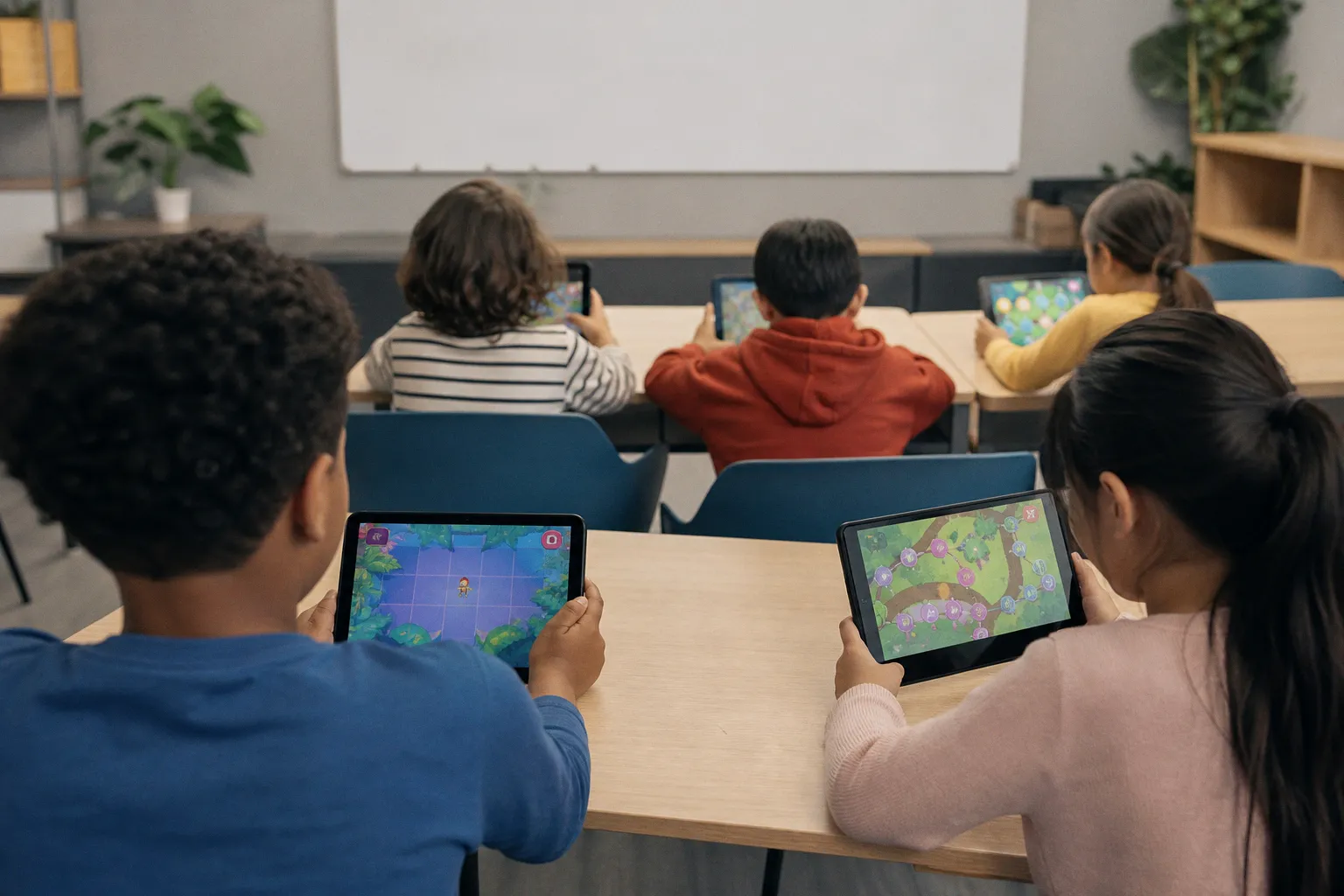
The EU report is a benchmark for implementation, not a product list
The official publication presents two practices from each of the 27 EU Member States, covering different education levels. Its stated focus is organized around three areas: digital competences, the future classroom, and digital well-being.
That structure is useful because it separates three problems that are often collapsed into one marketing category. A learning app may improve a narrow competence, but that does not automatically make it suitable for a classroom workflow. A puzzle game may create strong engagement, but that does not answer whether it supports retention, feedback loops, or healthy usage patterns. A platform may look modern, but the relevant question is whether it improves the instructional system around the learner.
For schools and developers, the report’s value is in comparative design logic. By showing practices across all EU Member States, it gives policymakers and education teams a way to look for transferable patterns rather than copying a single national model. The publication is explicitly intended to help schools, organisations, and policymakers adapt successful practices to their own contexts, which is the correct level of caution for digital education: context determines whether a tool becomes scaffolding or distraction.
Digital well-being is now part of the learning model
The report’s inclusion of digital well-being is not a side note. It signals that digital education is being assessed not only by access, engagement, or classroom novelty, but also by the quality of learner interaction over time.
That aligns with a separate Gulf Times report on children’s digital habits in Qatar, where Andrey Sidenko of Kaspersky’s Cyber Literacy Projects described early exposure to AI tools as a factor in children’s digital confidence and future workforce readiness. The same report also highlights risks: oversharing personal data, misuse of AI tools for cyberbullying or misleading content, and children not fully understanding how information shared with AI systems may be processed or stored.
For the edutainment market, this is a direct design constraint. If an educational game or AI-assisted learning app invites children to type, upload, chat, personalize avatars, or generate content, then digital hygiene is part of the pedagogy. Safety cannot sit outside the game loop as a parent setting buried three menus deep. It has to be built into prompts, feedback, default permissions, and the rhythm of interaction.
The stronger products in this category will therefore not be the ones that merely add AI features. They will be the ones that reduce unnecessary disclosure, make system limits understandable to children, and give educators enough visibility to intervene without turning play into surveillance.
What buyers should verify before adopting the next platform
The publication arrives as the broader education market continues to move toward digital offerings; a separate report notes that Pearson is navigating global education demand as its digital offerings expand, though the available source detail is limited. Taken together, the signal is clear enough: demand for digital learning infrastructure is rising, but buyers need more precise evaluation criteria.
For schools, parents, and programme leaders, the first filter should be pedagogical fit. Does the tool define the competence it is teaching? Does it sequence difficulty in a way that supports retention rather than producing a shallow gamification loop? Does it provide feedback that helps the learner correct thinking, or does it simply reward completion?
The second filter is classroom viability. A product that works for one child at home may fail in a classroom if it creates excessive teacher workload, unclear progress data, or fragmented attention. “Future classroom” should mean better orchestration of learning, not just more screens.
The third filter is digital well-being. Any platform used by children should be assessed for data-sharing behavior, AI interaction design, moderation risks, and whether it teaches responsible technology use through the experience itself.
The definitive reading is this: the new EU publication does not validate digital education as a category; it raises the standard for evidence, transferability, and learner protection. For educational games and learning apps, the return on investment will depend less on feature volume and more on whether the system can prove it teaches, scales, and safeguards at the same time.