Online educational games: fixing the curriculum mismatch
“Educational” is the most abused adjective in the app store.
Slap a few sums onto a racing game, add a cartoon owl that chirps “Great job!”, and suddenly we are supposedly witnessing a triumph of game-based learning. The child is engaged. The dashboard has confetti. Dopamine has done its tiny dance. But can the student now solve the type of problem sitting in next week’s math assessment? Often, nobody has bothered to ask.
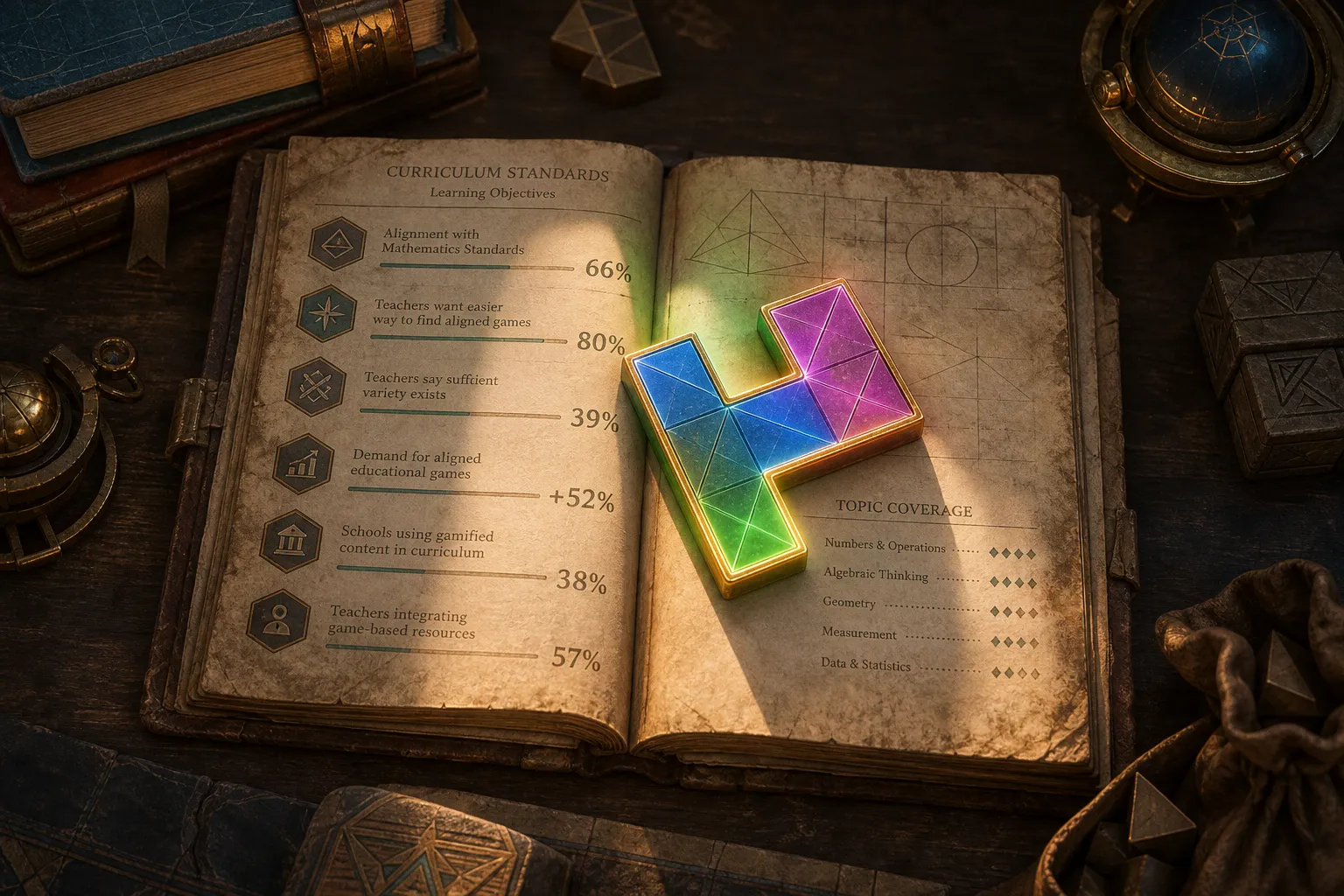
That is the curriculum mismatch in a nutshell. Online educational games can be lively, clever, and genuinely useful. They can also be beautifully animated detours around the lesson a class is actually meant to learn. In an evaluation of math learning-game apps, only 66% aligned with Common Core math standards. That is not a minor wrinkle. That is one in three apps wandering off the map while calling itself a navigator.
I have crash-tested enough classroom educational games to know the usual trick: the game teaches something, just not necessarily the thing the teacher needs taught on Tuesday at 10:15.
Engagement is not evidence of learning
The first game-based learning mistake is treating attention as proof of academic value.
A student can spend 25 focused minutes sorting fractions, matching vocabulary, managing a virtual ecosystem, or building a medieval city. That looks promising. It may even feel miraculous compared with a worksheet-induced classroom coma. But focus only tells us the game held attention. It does not tell us whether the player practiced the required skill, received usable feedback, or can transfer that skill beyond the game’s rules.
A game can be cognitively active and instructionally useless at the same time. Brutal, but true.
Take a typical online math game built around speed. The player fires off answers, earns coins, upgrades a spaceship, and gets a big audiovisual dopamine hit for every correct response. Fine. But which standard is being practiced?
- Is the student comparing fractions with unlike denominators?
- Is the student adding fractions, and if so, are visual models involved?
- Is the game assessing conceptual understanding or merely fact recall?
- Does it adjust when the student repeatedly makes the same error?
- Can the teacher identify the exact skill that broke down?
If the answer is “the child gets better at the spaceship game,” the game has done its job. It has not necessarily done the school’s job.
This is where serious games for students get unfairly blamed. The medium is not the problem. A good simulation can make a science concept tangible in ways a static textbook simply cannot. A historical strategy game can force students to reason about limited resources, competing incentives, and cause-and-effect. A geometry puzzle can turn spatial reasoning into something students want to wrestle with.
But a game needs a curricular spine. Without one, it is a toy wearing a lanyard.
A busy student is not automatically a learning student. The game must connect play, practice, feedback, and the target standard—without dropping a link.
The numbers expose the gap
Teachers are not imagining this problem. A national survey from the Joan Ganz Cooney Center found that 80% of teachers using digital games wanted it to be easier to find games aligned to their curriculum. Only 39% believed there was a sufficient variety of curriculum-aligned options.
That is the real market review, and it is less flattering than the promotional trailers.
Schools have adopted the format faster than publishers have solved the alignment problem. Roughly 38% of K–12 schools globally incorporate gamified content into formal curricula, while 57% of teachers integrate game-based resources. The appetite is there. The catalog is there. The clean connection between a game session and a learning objective? Still patchy.
The mismatch usually appears in one of four places:
1. The skill is too broad.
“Improves math” is not a learning objective. “Uses place-value reasoning to compare multi-digit numbers” is closer. Broad claims let publishers sound impressive while avoiding the hard work of precise instructional design.
2. The game drills a prerequisite, not the assessed skill.
A student may practice multiplication facts in a game when the current unit expects multi-step word-problem reasoning. Fluency helps, sure. But it does not substitute for the target.
3. The game’s reward loop hijacks the task.
When the fastest path to points is random guessing, repeating a memorized pattern, or exploiting a mechanic, the player learns the system rather than the content. Congratulations: you built a tiny casino with fractions.
4. The feedback is decorative.
“Try again!” is not feedback. A useful learning game identifies the misconception, gives a clue or representation, and lets the student apply the correction. That is where neuroplasticity gets more than a cameo appearance.
The 66% figure for Common Core-aligned math apps is useful precisely because it is not catastrophic. Two-thirds is not nothing. It proves that alignment is achievable. It also proves that “educational” does not guarantee it.
Start with the standard, not the game
Teachers often begin with a game because a colleague shared it, students keep asking for it, or the interface looks unusually less grim than the rest of the edtech shelf. I get it. Nobody wants to spend lunch parsing standards language.
Still, the sequence matters. Pick the learning target first. Then interrogate the game.
Here is the quick audit I use before letting an online educational game consume class time:
| Question | What a solid answer looks like | What should set off alarms |
|---|---|---|
| What exact skill does it teach? | A specific, grade-appropriate objective or standard | “Critical thinking,” “math skills,” or “brain training” |
| What does the player actually do? | Repeated actions directly practice the target skill | Most play happens in unrelated mini-games or cosmetic systems |
| How does the game respond to errors? | It reveals the misconception, offers scaffolding, then retries | It flashes red, removes a life, and moves on |
| Can students show transfer? | A follow-up task asks them to use the skill outside the game | Success exists only inside the game’s interface |
| What data reaches the teacher? | Item-level performance tied to skills or objectives | Total points, time played, badges, and vibes |
| Where does it sit in the lesson? | Clear use as introduction, guided practice, review, or assessment | “Whenever students finish early” |
That last row catches a lot of trouble. “Early finisher game” is not a pedagogical role. It is storage. Sometimes storage is necessary; classrooms are real places, not laboratory conditions. But call it what it is. Do not pretend a reward activity is a curriculum intervention.
For educational web games with thin reporting, I make the alignment visible outside the game. One learning objective on the board. One brief task before play. One task after play. Suddenly the game is not floating around the lesson like a balloon with an ad budget.
Build a three-part lesson around the game
The game itself should rarely carry the whole instructional load. It needs bookends.
Before play: name the target and surface prior knowledge.
If students are about to use a game on ecosystems, ask them to predict what happens when one population rises or a resource disappears. Give them a question worth pursuing, not just a login code.
During play: assign a cognitive job.
Students might track decisions, note failed strategies, capture evidence, or explain a choice to a partner. This stops the familiar “I was learning, honest” defense after 20 minutes of clicking.
After play: force transfer.
Ask students to solve a parallel problem, write a claim using evidence from the simulation, diagram the system, or explain why their in-game strategy worked. If they cannot do this, the lesson has produced gameplay, not durable learning.
Spaced repetition belongs here too. A single spectacular session with a science simulation is not mastery. Revisit the concept later through a short quiz, a new scenario, a paper-based problem, or a different game mechanic. The brain likes retrieval. It does not care that your platform has a premium skin.
Match the game’s role to the lesson
Not every classroom video game should be judged as a replacement for direct instruction. That is another category error.
A simulation game may be excellent for testing hypotheses but weak for introducing vocabulary. A fast-paced quiz game may work for retrieval practice but fail at conceptual explanation. Minecraft Education Edition can support design, collaboration, and spatial modeling, but dropping students into a giant sandbox without constraints is not a lesson plan. It is recess with better lighting.
Use the format for what it does well.
- Puzzle games work best when the learning goal involves patterns, logic, spatial reasoning, sequencing, or constrained problem-solving. Their weakness is hidden thinking: students can sometimes stumble into a solution without articulating the rule.
- Simulations shine when students need to see systems change over time: ecosystems, economics, physics, public health, engineering. Their weakness is complexity. Learners can get lost in the controls before they reach the concept.
- Narrative and history games can build context, perspective-taking, and causal reasoning. Their weakness is factual drift. A compelling historical atmosphere is not the same thing as historical accuracy.
- Quiz and retrieval games are good for recall, terminology, and low-stakes review. Their weakness is that speed can reward reflexes over reasoning.
- Creation platforms can generate deep work when the task has constraints, rubrics, and reflection. Without those, students mostly build impressive houses.
This does not mean the teacher must become a full-time game designer. It means the teacher needs to decide what the game is for. That is a much smaller ask, and a much more useful one.
If a game cannot survive the question “What will students know or do differently in 30 minutes?” it does not get class time just because the avatars are adorable.
Fix the reporting problem before it fixes your timetable
The ugliest weakness in online educational games is often not content. It is visibility.
Teachers need to know who is stuck, where they are stuck, and whether the game’s score means anything. Yet many platforms report the least useful metrics because they are easiest to display: minutes played, levels completed, streaks maintained, coins earned.
None of those is a learning outcome.
A useful teacher dashboard should let you distinguish between these students:
- the student who understands the concept but works slowly;
- the student who answers quickly by guessing;
- the student who repeatedly confuses two related ideas;
- the student who has mastered the current skill and needs a harder task;
- the student who has disengaged because the interface itself is the obstacle.
If the platform cannot provide that detail, add your own lightweight evidence. A two-question exit ticket does more instructional work than a thousand glittering achievement badges. Ask one question that mirrors the game and one that changes the context. The first checks performance. The second checks transfer.
For example, after a fraction game, do not ask students only to complete another game-style fraction item. Ask them to explain whether two recipe quantities are equivalent, or to justify which fraction is larger using a visual model. Make the knowledge leave the screen.
The demand surge will not solve this by itself
Demand for curriculum-aligned educational games has reportedly risen by nearly 52% as mobile learning ecosystems expand. That is not surprising. Schools want tools that can adapt, motivate, and survive the reality of mixed readiness levels.
But more demand can produce more quality—or more glossy nonsense. Usually both.
The next wave of online educational games will be judged less by whether they look engaging and more by whether they can prove instructional fit. Publishers need to stop treating standards alignment as a tiny logo in the footer. It should shape the game loop, the feedback system, the progression model, and the teacher data.
Here is what I would demand from any developer pitching a classroom game:
1. A clear map from gameplay actions to specific learning objectives. Not a vague subject label. A real map.
2. Multiple representations of the concept. Numbers, visuals, language, models, and explanations where appropriate. One trick rarely reaches every learner.
3. Feedback that diagnoses, not merely judges. The player needs to understand why an answer failed.
4. Meaningful difficulty progression. Harder should mean more sophisticated thinking, not faster timers and louder explosions.
5. Teacher controls that do not require a doctorate in dashboard archaeology. Assign, monitor, group, review. Done.
6. Evidence that success transfers beyond the game. This is the part marketing teams tend to mumble through. Make them answer anyway.
The future-proof classroom is not the one with the most screens. It is the one where every digital activity earns its square of floor space.
Do not download the promise; test the fit
I am not here to tell teachers to abandon online educational games. That would be lazy criticism. Good games can create repetition without monotony, make invisible systems visible, and give students more chances to fail safely and try again. Those are serious advantages.
But the bar has to move.
Download a game when it targets a skill your students are actually working on, makes their reasoning visible, gives feedback with teeth, and fits into a lesson with a beginning and an end. Keep it when students can demonstrate the learning away from the game.
Skip it when its best evidence is a mascot, a streak counter, and a sentence claiming it “makes learning fun.”
Fun is welcome. Alignment is non-negotiable.